
 Max Heyraud
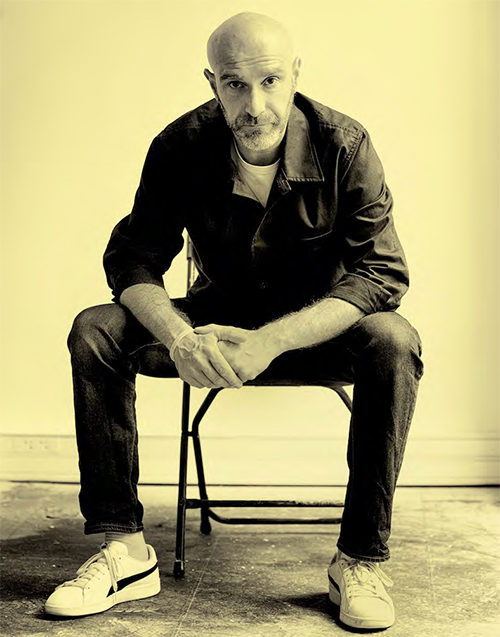
Ahead of his return to Glasgow for the legendary Pressure party with Slam, we spoke to Vitalic about OK Cowboy at 20, creative risk and why he still refuses to look back.
Twenty years on from releasing one of the most decorated electronic albums of the decade, OK Cowboy, Vitalic has no interest in winning laps. The French producer, whose real name is Pascal Arbez-Nicolas, speaks with a blend of clarity and defiance that has long characterised his output: he is sceptical of industry gatekeepers, allergic to nostalgia, and still pursuing the same visceral spark that drove his breakthrough.
Although the record’s 20th anniversary may inspire awe, he views it more as a milestone than a monument, commemorating it with a few carefully selected performances rather than a comprehensive retrospective tour.
That conflict between introspection and forward motion permeates his thoughts. In the canon of French electronic music, OK Cowboy may now coexist peacefully with classics like Homework and Discovery, but Vitalic dismisses the framing. The circumstances that made it possible, risk, instinct, and a readiness to stray from what seemed safe or expected, are what he is more interested in.
He is still guided by the same instinct. He avoids fetishising the process and instead concentrates on the interaction between the artist and the machine, whether using contemporary digital tools or analogue synths. He is more conflicted about the cultural trajectory of electronic music itself, even though he recognises the extent of technological change, especially the emergence of AI. He now sees a scene that is more and more focused on spectacle over substance, repetition over risk, whereas the early 2000s felt exploratory, even volatile.
There’s no sense of resignation, though. If anything, Vitalic seems more dedicated than ever to the idea that real breakthroughs come as a surprise, to the album as a storytelling medium, and to the dancefloor as a venue for emotional transmission. Twenty years later, the fire that gave rise to OK Cowboy hasn’t gone out; it’s just found new ways to burn.

You’re touring your seminal album, OK Cowboy, as you celebrate 20 years of the record. How does it feel to be marking such a milestone?
I’m very happy to have stood the test of time and trends. Back then, I had no idea where I was headed! I don’t think I ever could have imagined back then that one day I’d be celebrating the 20th anniversary of this record. I’m not doing a special anniversary tour, just a few dates here and there in meaningful venues. I’m happy to be returning to Glasgow, which has always held a very special place in my heart.
How do you feel about nostalgia in general, especially when it concerns your own work?
No, nostalgia isn’t my driving force at all. That’s actually why I’m not really doing an anniversary tour. Nostalgia can be a creative energy when I use past sensations in my music, but I don’t look back, even if that era was absolutely incredible, with so many new things emerging. For me, as a person, it was a time of firsts. My first trips abroad, far from home… my first festivals on massive stages or in small New York clubs. I look back on it with affection, but I’m still experiencing very exciting things, and luckily, creativity is still with me.
I read the Pitchfork review from 2005, which placed the album alongside Daft Punk’s Homework and Discovery. How did you take that comparison at the time?
I don’t give Pitchfork any credibility whatsoever. They want to be seen as tastemakers, but they’re essentially followers with contempt. They just go whichever way the wind blows, without any real commitment. No comment.
Without fawning over the album too much, I do think it works perfectly both as a dancefloor record and a home-listening one. Were you conscious of trying to achieve that duality while making it?
Indeed, I want my albums to always have one foot on the dancefloor – but not only. If I only wanted to make dance music, I’d stick to short formats. Even if it feels a bit obsolete, I still believe that an album is the right format to convey different types of energy and emotion. That’s what I’ve done since my first album, and it’s what I continue to do now.
The albums that truly matter to me are all full-length records that tell a story. I draw inspiration from them to tell my own. I love cinema and experimental stretches, and I think you can hear that in my music.

I’m keen to hear about Poney Part 1, one of my favourite tracks of all time. What do you remember from making that? What was the studio setup like, and did you realise how impactful it would be when you initially made it?
No, I had no idea of the impact it could have, because the track was so different from what they were doing at the time. As a musician, however, I was satisfied with the result because it was exactly what I was looking for. It also signaled a change of direction in my musical production—the beginning of taking real risks. Getting out of your comfort zone when making music is something very exciting, maybe even intoxicating.
I’d done quite a bit of research on how to use the vocoder in a way that was different from what people knew. I also looked into new ways to create a bassline that would be rock, straight, and unstable all at once. I also embraced a part of my own madness in the music, without trying to please everyone at all costs.
This track was the creative spark for so many things for me. I wouldn’t say it’s my favorite, but I certainly have a lot of affection for it. Over time, I’ve also come to understand the true meaning of the song. It does indeed touch on animal cruelty—ponies forced to turn in circles in fairground rides all day—but it also metaphorically addresses the idea of missing out on your own life and who you truly are. In the end, I was talking about myself without even knowing it
I also have the “My Friend Dario” single on 12-inch, a lucky find from a Dublin record store, but I wanted to ask specifically about the remix. It feels like it’s always flown under the radar a bit. Can you tell me about the process and what you remember from working on it?
This track was the first one I composed for the album, but it took me three years to finish. My initial idea, which I’d had for a long time, was to create a rock song without any guitars, any real singer, or even any actual instruments. That’s why the music video shows people playing air guitar. Today, you could do that with AI in a matter of seconds, but in 2002, it required an immense amount of work, experimentation, and trial and error.
It was also the last track I mixed in Brussels, and the one that demanded the most effort. In my ‘lo-fi’ demo, the sound worked well, but with a clean, professional mix, the whole track just fell apart. I also distanced myself from the seriousness of my previous music. When I talk about taking risks, this was part of it—staying ‘arty’ without taking myself too seriously.
I still love playing it live for its uncompromising energy. It just puts you in a great mood.

I know you’ve historically worked with a lot of vintage sounds, which definitely contribute to your signature style. Are you using many VSTs and digital tools now, or do you still prefer keeping it old school?
I’ve always used a mix of analogue synths and more digital tools, whether they’re VSTs or digital hardware. I don’t care much about the format; what matters to me is the relationship I build with the tool. It’s true that I feel a stronger connection to my analogue and modular synths than to VSTs in a computer, but I don’t want to close myself off to any way of creating music. I embrace creativity wherever I find it, with total enthusiasm!
Looking back since 2005, do you think electronic music has evolved in the way you imagined? With rapid technological advancements and new sounds emerging in the early years, how do you compare that to current dance music trends?
There has indeed been an immense amount of technological progress, and we musicians were waiting for it with bated breath. I’m speaking particularly about stem separation and AI. The machines have become incredibly powerful, and the new possibilities are endless.
From an artistic standpoint—and I’m going to be a bit radical here—I think the scene has truly changed. Back in the early 2000s, you could say the ratio was 80% music and 20% visuals. That ratio has completely flipped. Music is struggling to reinvent itself, constantly repeating itself through remixes and edits. Ultimately, the audience isn’t really coming to discover new things or experience sensations anymore; they’re coming to witness mega-shows that leave little room for improvisation and put ‘costumed clowns’ centre stage.
I often say that if pottery could make you more famous and richer than techno in a matter of weeks, all these DJs would quit music on the spot to go and make terracotta vases. I’m an optimist, though, and I believe that one day the public will realise what’s happening.

You play alongside Slam for the legendary Pressure parties. What’s your relationship with these Scottish techno stalwarts?
With Slam, it’s a 25-year-long story! I’ve been to Glasgow countless times to play at The Arches for those legendary nights that will be forever etched in my heart. I’ve also shared the stage with them many times at festivals, followed by some pretty wild backstage parties. Before all that, when I was a teenager, I used to listen to their music on loop on my Walkman and collect their vinyl. They’re two guys who are deeply in love with music, who never compromised themselves, and they have truly big hearts.
There’s been a lot of discourse about the lack of anthems being made currently. As someone who’s created multiple era-defining tracks, I’d love to hear your take on this.
I feel the same way. There are one or two hits a year, but nothing like what we saw for decades. When I mentioned that music is struggling to reinvent itself, this is exactly what I meant. The techno movement is fantasising about an era and a culture that it has hollowed out. By that, I mean people talk about rebellion and freedom all the time, but in the end, they’re just marketing arguments.
As for the music, it remains stuck in the past, adopting codes and a rigid set of specs that it refuses to stray from, for fear of being sidelined. The thing is, a hit is usually something that comes out of nowhere, something unexpected that breaks the mould. Once again, I trust that things will change in the future.

Finally, do you have any words of wisdom or reflections looking back on your career, from the early years until now?
Looking back, I’ve truly given my life to music, with a full heart and deep passion. Even though there were times when it wasn’t easy, I’ve learned so much, and above all, I felt like I belonged. When I was a child, I dreamed of owning synthesisers and making people dance. It has also been a fascinating journey through the evolution of the industry and various technological revolutions
I’ve always kept that fire burning inside me. Even now, I love isolating myself in the studio. This hunger to create emotions and to experiment is as vibrant as ever. And I still have that same excitement whenever I step on stage. This story isn’t over yet, and as long as I have something to say, I’ll keep going!
Photo Credits: Kevin Gay & Henri Coutant, David Hugonot Petit, Charlie le Mindu
